Your Triathlon Swim Technique Is Costing You Time - it's probably not a fitness problem
Quick summary: Most triathletes lose far more time in the swim than they realise — and the cause is almost never fitness. It's technique. Here's what's actually slowing you down, and what to do about it before your next race.
 It's May. Race season is here — or close enough that you can feel it.
The long rides are happening. The run training is building. And yet, for a huge number of triathletes, the swim is still the thing that causes the most anxiety, costs the most time, and gets the least useful attention.
I hear the same things every year at this point in the season:
"I just need to get through the swim."
"I'm not a natural swimmer."
"I've been putting in the pool sessions, but I'm still not getting faster."
Here's what I've learned after nearly twenty years of coaching triathletes of all abilities: for most people, the triathlon swim is not a fitness problem. It's a technique problem. And that is actually good news — because technique can be fixed.
Why More Pool Laps Won't Make You a Faster Triathlon Swimmer
There's a temptation, especially at this time of year, to just do more. More pool sessions. More distance. More drills you found on YouTube at midnight.
I understand the logic. The race is coming. You need to be ready. More must mean better.
But here's the uncomfortable truth: if your freestyle technique is inefficient, you are training yourself to be more efficient at swimming slowly. You're engraining the problem, not solving it.
Swimming is unique in triathlon because effort and output can be almost completely disconnected. You can thrash, pull, kick, fight the water — and your pace barely changes. Meanwhile, someone who looks half-asleep in the next lane glides past you. They're not fitter. They're not doing twice the training. They're just not fighting.
The water rewards efficiency. Almost nothing else.
The Three Technique Problems Slowing Most Triathletes Down
I'm not going to give you a list of twenty things to work on. That's not useful, and you don't have time for it. Here are the three things I see most often that make the biggest difference to swim speed and efficiency.
1. Head Position in Front Crawl
This is the one that surprises people most. If your head is too high — looking slightly forward rather than straight down — your hips drop. Your legs sink. You are now dragging significant resistance through every single stroke for the entire length of the pool.
Dropping your head one or two centimetres can transform how your body sits in the water. That is not an exaggeration. It's physics. And it's one of the first things I look at in every swim technique session.
→ Read more: The Importance of Body Position in Front Crawl
 2. The Catch Phase — Where Most Swimmers Lose Their Power
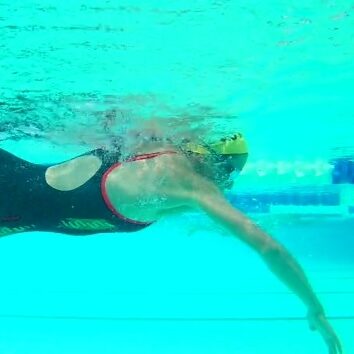
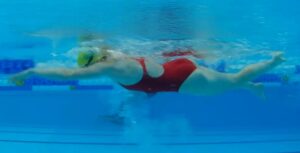
The catch is the moment your hand enters the water and begins to apply pressure. Most swimmers — even experienced ones — drop their elbow too early, turning the hand downward instead of pressing it backward. When that happens, you're not pulling water. You're just stirring it.
A proper high-elbow catch means your hand and forearm become a paddle driving you forward. Without it, you're losing a significant portion of propulsion from every stroke. Every. Single. Stroke.
→ Read more: The Catch Phase in Front Crawl — Where Speed Truly Begins
3. Breathing Anxiety and Broken Rhythm
Bilateral breathing sounds like the answer. And for some people, it is. But for many triathletes, the desperate urgency around breathing is the root cause of the head-lifting, the broken rhythm, and the stroke that falls apart every third length.
If you're anxious in the water, your breathing reflects that. And your technique follows.
Calm, controlled breathing — even if that means breathing to one side more often — changes everything. The goal is relaxation, not rules.
→ Read more: Breathe Easy: Why Exhaling Underwater Makes Freestyle Feel Effortless
Why You Can't Fix Your Swim on Your Own
Here's the real problem with working on your freestyle technique independently: you can't see yourself swim.
You have feel. You have instinct. You might have your Garmin telling you your pace. But you don't have eyes on what your body is actually doing in the water — and there is almost always a significant gap between what swimmers think they're doing and what they're actually doing.
I've been doing swim video analysis for years. The reaction when an athlete first watches themselves swim is almost always the same: genuine surprise. Not always bad surprise — sometimes people are better than they thought — but almost always an "oh, that's what I'm doing" moment.
That moment is where real improvement begins.
How to Improve Your Triathlon Swim Technique Before Your Next Race
You have a couple of options, and given where we are in the season, I wouldn't leave either of them too long.
Option 1: Book an Online 1-2-1 Swim Technique Session — £39
This is a personalised coaching session built entirely around your stroke — your weaknesses, your movement patterns, and what you specifically need to work on before race day.
It's not a group class. It's not a generic drill video. It's focused, expert attention on the things that will actually move the needle on your swim split.
Before the session, you send video of yourself swimming. Paul reviews it in detail. By the time you meet online, you already know what you're working on — and you leave with two or three clear, prioritised changes and a written summary to take back to the pool.
→ Book your Online 1-2-1 Swim Technique Session — £39
Option 2: Go Deeper on the Technical Side
If you want to understand the mechanics before booking anything, the articles below cover the key elements of efficient front crawl in detail:
- The Catch Phase in Front Crawl — Where Speed Truly Begins
- The Importance of Body Position in Front Crawl
- Breathe Easy: Why Exhaling Underwater Changes Everything
Read those three and you'll understand more about efficient swimming than most club triathletes — and you'll probably identify yourself in at least one of them.
Frequently Asked Questions: Triathlon Swim Technique
Why am I not getting faster at swimming despite training regularly? Almost always, the answer is technique. If your stroke has fundamental inefficiencies — in your head position, catch, or breathing — adding more yards simply makes you better at swimming slowly. The fix is identifying exactly what's wrong and changing it, not doing more of the same.
What is the most important part of freestyle technique for triathletes? Body position and the catch phase are the two highest-return areas for most swimmers. A flat, horizontal body creates less drag. A strong high-elbow catch generates significantly more propulsion. Fix both and almost every other aspect of your stroke improves as a result.
How much can improving swim technique improve my triathlon time? For most age-group triathletes, the swim is not where the race is won — but it absolutely sets up everything that follows. A controlled, efficient swim means you arrive at T1 less fatigued and less stressed, which directly impacts your bike leg. Technique improvements of 2–4 minutes on a 1500m swim are common with targeted coaching.
Is an online swim technique session as effective as in-person? For technique analysis and coaching, yes. The majority of a swimmer's technique is visible on video — and being able to pause, rewind, and annotate footage is often more useful than poolside coaching in real time. The limitation is that drills can't be directly supervised, but the action plan you leave with is just as applicable.
What should I focus on in the last few weeks before a triathlon? At this point in the season, don't try to overhaul everything. Pick one or two specific technical changes — ideally identified through proper coaching — and focus on making them automatic. Confidence and relaxation in the water are as important as mechanics by this stage.
One Last Thing
Most triathletes significantly underinvest in their swim relative to how much time they lose there on race day.
The bike gets the power meters, the race wheels, the aero kit. The run gets the structured tempo sessions. The swim gets the extra laps on a Wednesday evening and a quiet hope that it'll be fine.
It can be better than fine. A controlled, efficient triathlon swim doesn't just save minutes — it sets up the rest of your race. You arrive at T1 less fatigued, less stressed, and ready to ride well.
That is a better race. From the moment you hit the water.
 Paul Jones is a British Triathlon Level 3 Coach and IRONMAN Certified Coach, and founder of F4L Triathlon Coaching. Based in the North East of England, he coaches athletes of all levels — from first-time triathletes to IRONMAN finishers.
Explore coaching programmes → | Book a swim technique session →
 Train Your Mind. Transform Your Race. Join F4L.
Triathlon isn’t just a test of physical endurance. It’s a mental crucible. The athletes who thrive aren’t just the fastest—they’re the ones who know how to stay calm in chaos, grounded in discomfort, and focused when everything else is trying to pull them off course.
That’s why mindset matters. And why F4L Triathlon Coaching is built around more than just metrics and mileage. We coach the whole athlete—body, mind, and spirit. Whether you’re chasing a personal best, your first finish line, or simply want to feel more confident in your training, F4L offers a coaching experience rooted in stoic principles and emotional intelligence. We help you:
- Focus on what you can control
- Prepare for the unexpected
- Embrace the journey
- Build resilience through discomfort
- Stay present in every moment
- Keep perspective when it counts
- Show up and do the work
This isn’t just theory—it’s how we train. Every session, every plan, every conversation is designed to help you become the kind of athlete who doesn’t just endure, but evolves.
If you’re ready to train smarter, race stronger, and think clearer—join us.
👉 Sign up for F4L Triathlon Coaching and start building the mindset that lasts